Regulatory status: LiveMARCH™ and CHARM™ dynamic reordering features are under FDA review. They are not FDA-cleared. The Sempulse Halo monitor is FDA-cleared for vital signs monitoring as described in clearance K232495.
What Is LiveMARCH™

The MARCH Algorithm Has Been Fixed for Decades. It Doesn't Have to Be.

Since the 1990s, the TCCC MARCH algorithm has guided combat medics through trauma assessment in a fixed sequence: Massive hemorrhage, Airway, Respiration, Circulation, Hypothermia and head injury. That order was the safest statistical default when medics had no real-time data on which system was deteriorating fastest. LiveMARCH™ technology changes the premise entirely.

The Problem with Fixed Sequence

The standard MARCH sequence defaults to statistical mortality patterns from historical conflict data. It is the best possible default when no physiologic data is available in real time. But it is not the best possible answer when real-time, multi-system data exists. Minutes spent working the wrong priority are minutes the actual threat advances.

📈

Simultaneous, Multi-System Measurement

The Sempulse Halo wearable monitor continuously measures all five MARCH-relevant physiologic systems at once, from a single sensor applied in under 10 seconds. That simultaneous multi-system data stream is the capability that makes a dynamic MARCH display possible for the first time.

🏆

A First: Dynamic Reordering at Point of Injury

Continuous, simultaneous, multi-system physiologic monitoring at the point of injury, combined with dynamic reordering of the MARCH assessment display by current threat level, has not previously been proposed or published. LiveMARCH™ is patent pending. This capability is under FDA review.

"One medic can physically assess one body system at a time. Until now, there was no way to measure all five MARCH systems simultaneously. Halo measures all five at once. LiveMARCH™ makes the display lead with what the data says matters right now."

Sempulse Corporation  •  LiveMARCH™ technology is under FDA review and not currently FDA-cleared.

Why It Matters

Preventable Combat Death Is a Sequencing Problem

Research published over two decades of military conflict shows that a substantial proportion of combat deaths are potentially survivable with faster, better-targeted intervention at the point of injury. The CoTCCC MARCH algorithm addresses priorities in order of statistical likelihood. LiveMARCH™ technology addresses priorities in order of real-time data.

Scenario 1

Pulsatile Hemorrhage

M Leads

Massive hemorrhage is both the statistical and data-confirmed top priority. The LiveMARCH™ display surfaces M first. Algorithm and physiology agree. The medic attacks the bleed without wasted assessment time on systems that are not yet deteriorating.

Scenario 2

Inhalation Burn, No External Bleed

A Leads

Burn-related airway swelling closes fast, but statistical sequence places M first. The LiveMARCH™ display detects no hemorrhage signature and surfaces A at the top. The medic goes to the airway immediately, not after clearing a finding that is not present.

Scenario 3

Cold-Water Immersion, TBI

H Leads

No obvious bleed, no airway compromise. The immediate killers are hypothermia and head injury. Without dynamic reordering, the medic burns minutes ruling out M, A, R, and C. The LiveMARCH™ display surfaces H first. Cold stops advancing sooner.

Scenarios are illustrative concept descriptions only. LiveMARCH™ technology is under FDA review. Performance claims are subject to clinical validation.

17g
Halo monitor weight,
IFAK-compatible
<10s
Application time
at point of injury
5
MARCH systems measured
simultaneously
110hr
Up to 110-hour
battery life

Halo hardware specifications. LiveMARCH™ dynamic reordering features are under FDA review.

How It Works

From Sensor to Sorted Display

1

Apply Halo in Under 10 Seconds

The Sempulse Halo wearable applies to two proprietary body acquisition sites and begins reporting FDA-cleared vital signs within approximately 15 seconds. No calibration, no cuff, no gel. Single-button operation.

2

Continuous Multi-System Monitoring

Halo simultaneously streams data covering all five MARCH physiologic domains continuously. The patient enters the LiveCharts roster automatically. Triage tier derives from live data. No manual entry at pairing.

3

LiveMARCH™ Display Reorders by Threat

The LiveMARCH™ patient card displays MARCH letters sorted by which system is deteriorating fastest, with color coding by threat severity. The medic taps the leading letter to log signs, symptoms, and treatments from a CoTCCC-aligned list. No typing required. Under FDA Review

4

One Tap to Document and Handoff

A single handoff action generates the complete TCCC documentation packet from the live patient record: DD Form 1380, 9-Line MEDEVAC, MIST, PFC card, and Joint Trauma System AAR. The care record travels with the patient through every echelon. No re-entry at any transition. Under FDA Review

Platform Architecture

Three Components, One Pipeline

Sempulse Halo Monitor

FDA-cleared wearable vital signs sensor. IP67, MIL-STD-810 validated. 17g. Up to 110-hour battery. BLE 5.0 Long Range.

LiveCharts Application

Multi-patient real-time monitoring app. Across-patient acuity sort. LiveMARCH™ within-patient display (under FDA review). Works offline.

Command Cloud

Secure cloud data aggregation platform. Command-level visibility. AAR submission to Joint Trauma System. ATAK and NGC2 integration.

Military Mode: A single configuration flag activates the full LiveMARCH™ TCCC documentation surface, including MARCH-mapped vital display, threat-color reorder, PAWS secondary panel, and the complete handoff packet builder. Civilian deployments see a clean clinical product. Military deployments get the full TCCC surface. LiveMARCH™ Military Mode features are under FDA review.

Civilian Adaptation

CHARM™: Dynamic Triage for Civilian Emergency Medicine

LiveMARCH™ is designed around military TCCC doctrine. CHARM™ brings the same dynamic threat-sorting principle to civilian emergency medical services, mass casualty incident response, disaster medicine, and emergency department triage.

One Engine, Two Contexts

The underlying technology in both LiveMARCH™ and CHARM™ is the same: real-time, simultaneous multi-system physiologic monitoring that surfaces the highest-deterioration assessment priority first. LiveMARCH™ maps to CoTCCC MARCH PAWS doctrine and military documentation workflows. CHARM™ maps to civilian trauma assessment frameworks and EMS handoff protocols.

Both operate on the Sempulse Halo wearable platform and integrate with the LiveCharts monitoring application. Configuration determines which documentation surface, assessment framework, and handoff workflow is presented to the provider.

CHARM™ technology is under FDA review and is not currently FDA-cleared.

CHARM™ Use Cases

Civilian Emergency Applications

Under FDA review. Target applications include:

  • Mass casualty incident (MCI) response and MASCAL triage for civilian EMS teams
  • Disaster medicine and search-and-rescue physiologic monitoring
  • Prehospital trauma care by paramedics and emergency medical technicians
  • Emergency department triage and rapid multi-patient monitoring
  • Wilderness and remote medicine where time to definitive care is extended
  • Firefighter and law enforcement tactical medical support
  • Event medical coverage for high-risk environments and large gatherings
TCCC Documentation

Every Required Form. One Patient Record.

At MASCAL tempo, documentation is the first thing that fails. Each form becomes its own workflow. Identity, mechanism of injury, and time of injury are re-entered into every template. LiveMARCH™ Military Mode collapses five separate documentation tasks into a single patient card.

DD Form 1380

TCCC casualty card rendered directly from the live patient record. Pixel-accurate PDF output. Auto-populates from captured care actions, timestamps, and vital signs data.

9-Line MEDEVAC

Lines 1, 3, and 5 auto-fill from GPS, triage tier, and vital signs data. One action transmits the complete request to the tactical operations center.

MIST Handoff

Mechanism, Injuries, Signs, Treatment. Structured handoff report derived from the same patient record. No re-entry at the transition point.

PFC Card (JSOM v25)

Prolonged Field Care card formatted to the current JSOM standard, populated from the live patient card, ready to travel with the casualty.

JTS After-Action Report

Joint Trauma System AAR generated post-handoff and submitted to Command Cloud for enterprise aggregation and continuous improvement analysis.

Care Continuity at Every Echelon

Any provider from ASM to CPP sees the same patient card and continues from where the prior provider left off. Records gate on acceptance acknowledgment at each handoff.

All LiveMARCH™ documentation features are under FDA review and not currently FDA-cleared.

Intellectual Property

LiveMARCH™ Is Patent Pending

Sempulse has filed a patent application covering the system and method for dynamic reordering of sequential clinical assessment algorithms based on continuous multi-system physiologic sensor input. LiveMARCH™ and CHARM™ are applied-for trademarks of Sempulse Corporation.

Patent Status
Pending
Trademark
LiveMARCH™
Trademark
CHARM™
Frequently Asked Questions

MARCH Algorithm, TCCC, and LiveMARCH™

Answers to the most common questions from military medical professionals, TCCC instructors, CoTCCC researchers, trauma physicians, emergency medicine practitioners, and defense acquisition teams.

What is LiveMARCH™ technology and what does it do? +

LiveMARCH™ is Sempulse's patent-pending, FDA-review-stage display technology for the Sempulse Halo platform. It dynamically reorders the TCCC MARCH algorithm assessment sequence within a single casualty based on real-time, simultaneous multi-system physiologic monitoring. Rather than following M-A-R-C-H in fixed statistical order, the LiveMARCH™ display surfaces the highest-deterioration MARCH system first, giving medics a data-driven starting point for care at point of injury.

Doctrine does not change. The medic still works through MARCH. The display leads with what the data says matters right now, not what the algorithm defaults to when no data is available. LiveMARCH™ technology is under FDA review and is not currently FDA-cleared.

What does MARCH stand for in TCCC and why is it in that order? +

In Tactical Combat Casualty Care, MARCH stands for: M = Massive hemorrhage, A = Airway, R = Respiration, C = Circulation, H = Hypothermia and head injury. The letters are ordered by statistical mortality impact, derived from decades of battlefield casualty data. Massive hemorrhage is first because compressible hemorrhage is the leading cause of preventable death in combat, accounting for the majority of potentially survivable battlefield fatalities.

The fixed order reflects what kills most casualties most often. It does not reflect what is killing any specific casualty right now. That distinction is the gap that LiveMARCH™ technology is designed to address.

How is LiveMARCH™ different from the standard MARCH algorithm? +

The standard MARCH algorithm is a fixed sequence: M, then A, then R, then C, then H. It does not change based on what the individual casualty in front of you is experiencing. It is the best default when no real-time physiologic data is available, and it has saved countless lives since its adoption by CoTCCC.

LiveMARCH™ technology uses real-time physiologic data from the Sempulse Halo wearable, which simultaneously measures all five MARCH-relevant body systems, to reorder the display by which system is deteriorating fastest in this patient right now. The medic still works through MARCH. The LiveMARCH™ display simply leads with the highest current threat rather than defaulting to the fixed statistical sequence. This is a display innovation, not a doctrine change. LiveMARCH™ is under FDA review.

What is MARCH PAWS and how does LiveMARCH™ relate to it? +

MARCH PAWS is the expanded TCCC Tactical Field Care algorithm. PAWS stands for: P = Pain management, A = Antibiotics, W = Wounds, S = Splinting. MARCH PAWS covers the full scope of field trauma care from life-threatening injuries through secondary injury management.

LiveMARCH™ technology addresses the MARCH portion of the algorithm, dynamically reordering the five MARCH assessment priorities by current threat. The LiveMARCH™ patient display includes a separate PAWS secondary panel for logging pain, antibiotic administration, wound documentation, and splinting, all from the same patient card without typing. LiveMARCH™ features are under FDA review.

What is CHARM™ and how does it differ from LiveMARCH™? +

CHARM™ is Sempulse's civilian adaptation of LiveMARCH™ technology. It applies the same dynamic physiologic threat-sorting principle to civilian emergency medical services, mass casualty incident response, disaster medicine, and civilian trauma assessment frameworks. Where LiveMARCH™ maps to CoTCCC MARCH PAWS doctrine and military TCCC documentation, CHARM™ maps to civilian trauma assessment protocols and EMS handoff workflows.

Both operate on the same Sempulse Halo hardware and LiveCharts application platform. A configuration flag determines which documentation surface and assessment framework is presented. CHARM™ is under FDA review and is not currently FDA-cleared.

Can LiveMARCH™ be used in mass casualty (MASCAL) situations? +

The Sempulse platform is designed for multi-patient, high-tempo environments. The LiveCharts application supports simultaneous monitoring of multiple patients, with an across-patient roster view that auto-sorts by acuity. The LiveMARCH™ within-patient display then surfaces the highest-deterioration MARCH system first for each individual casualty.

This combination addresses both levels of MASCAL triage: who is most critical across all patients, and what is most critical within each patient. The LiveMARCH™ Military Mode documentation system is also specifically designed for MASCAL tempo, eliminating the duplicate data-entry workflows that cause documentation to fail under pressure. LiveMARCH™ features are under FDA review.

How does LiveMARCH™ handle MEDEVAC documentation and 9-Line generation? +

LiveMARCH™ Military Mode generates the complete TCCC documentation packet from a single patient record, including the 9-Line MEDEVAC request, DD Form 1380, MIST handoff, PFC card, and Joint Trauma System After-Action Report. Lines 1, 3, and 5 of the 9-Line auto-populate from GPS position, triage tier, and vital signs data. The medic does not open a separate 9-Line form. They care for the casualty. The documentation generates on demand at handoff.

The complete care record travels with the patient through every echelon. Any provider at the receiving end sees the full history and continues care from where the prior provider left off. LiveMARCH™ documentation features are under FDA review.

Is dynamic MARCH reordering supported by existing TCCC or CoTCCC research? +

The underlying physiologic principles behind the MARCH algorithm are grounded in decades of CoTCCC research and battlefield casualty data. The fixed MARCH sequence was established precisely because simultaneous multi-system physiologic measurement at point of injury was previously impossible without more extensive medical equipment.

Continuous wearable monitoring that covers all five MARCH physiologic domains simultaneously, in a device weighing 17 grams that applies in under 10 seconds, is a new capability. Sempulse believes LiveMARCH™ represents the first proposed system for dynamic, data-driven MARCH reordering at point of injury. This has not previously been published or proposed in the CoTCCC literature to Sempulse's knowledge. LiveMARCH™ is patent pending and under FDA review.

What vital signs does the Sempulse Halo monitor measure? +

The FDA-cleared Sempulse Halo monitor measures oxygen saturation (SpO2), pulse rate, respiratory rate, core body temperature, and skin temperature, as well as body orientation and movement. These FDA-cleared parameters cover the physiologic domains relevant to all five MARCH algorithm assessment categories.

Additional parameters including Compensatory Reserve Measurement (CRM) and others are under FDA review as part of the Halo SE0002 submission. The across-patient acuity sort in LiveCharts operates on FDA-cleared parameters. The LiveMARCH™ within-patient dynamic reorder function incorporates parameters that are under FDA review.

Does using LiveMARCH™ require changing TCCC doctrine or CoTCCC training? +

No. The MARCH assessment sequence, CoTCCC guidelines, and TCCC doctrine do not change with LiveMARCH™ technology. The medic still works through MARCH. The LiveMARCH™ display is a reordering of the display surface, not a change to the underlying clinical protocol. A medic trained in TCCC reads the same MARCH letters and performs the same interventions. The only difference is that the display leads with what live data says is deteriorating fastest, not what statistical default places first.

LiveMARCH™ is designed to enhance existing TCCC training and doctrine, not replace it. LiveMARCH™ is under FDA review and not currently FDA-cleared.

How does LiveMARCH™ support care handoff from point of injury through echelons of care? +

LiveMARCH™ Military Mode is designed around care continuity through all echelons. At handoff, the sending provider taps the Handoff button. The full documentation packet renders from the patient record and transmits to the receiving provider by BLE pairing, scan, or on-network selection. The Halo device re-pairs to the receiving provider's phone. The sending provider's card moves to a Recently Handed Off queue.

Records gate on acknowledgment from the receiving provider. Any role from an Army Special Operations Medic to a Critical Care Paramedic sees the same patient card, picks up where the prior provider left off, and continues adding to a single continuous record. That record generates every required form at every subsequent transition. LiveMARCH™ handoff features are under FDA review.

How can my organization evaluate or procure LiveMARCH™ technology? +

Sempulse works with U.S. military units, government agencies, allied defense organizations, and emergency response organizations. The Sempulse Halo platform is FDA-cleared for vital signs monitoring and is currently fielded across military and civilian care environments. LiveMARCH™ and CHARM™ features are under FDA review and will be available to qualified evaluators and early-access partners on a program-specific basis.

To inquire about evaluation programs, procurement, clinical research collaboration, or regulatory documentation, contact Sempulse Corporation through sempulse.com.

Get in Touch

Ready to Learn More?

Contact Sempulse to discuss LiveMARCH™ evaluation, the Sempulse Halo platform, regulatory documentation, or research collaboration opportunities.

LiveMARCH™ and CHARM™ technologies are under FDA review and are not FDA-cleared. The Sempulse Halo monitor is FDA-cleared under K232495 for vital signs monitoring. LiveMARCH™ is patent pending. LiveMARCH™ and CHARM™ are applied-for trademarks of Sempulse Corporation.

Field Triage with Sempulse Halo and the LiveMARCH™ Algorithm

The LiveMARCH™ algorithm is patent pending and allows triage users to dynamically move through the MARCH algorithm. The CHARM™ algorithm is the civilian version of the LiveMARCH™ algorithm

LiveMARCH™ and CHARM™ are trademarks and are under active development and not cleared for use by the FDA at this time.
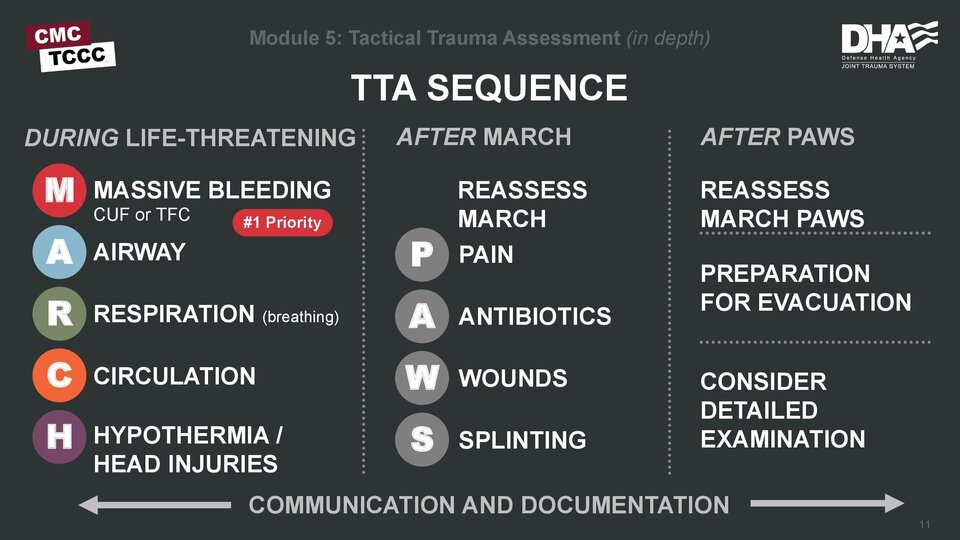
The M.A.R.C.H Algorithm

Tactical Combat Casualty Care (TCCC) emerged in 1996 by special operations forces stemming from lessons learned during previous conflicts with large scale adoption by US and allied forces after the events of September 11, 2001. Tactical Combat Casualty Care guidelines are evidence-based and battlefield-proven to reduce deaths at the point of injury (POI). Department of Defense (DOD) and most NATO allies require TCCC training for deploying forces because it combines effective tactics and medicine to reduce preventable death. TCCC teaches first responders to treat casualties in the proper order, treating the most critical situations first. This is accomplished by using the MARCH algorithm for easy memorization for seasoned medical providers as well as immediate responders using self-aid and buddy aid. There are many variations of the MARCH algorithm that adds tasks both before and after, but the base to prevent most preventable death is MARCH.

The MARCH algorithm is laid out differently from Advanced Trauma Life Support (ATLS) which used Airway, Breathing, and Circulation (ABC’s) as the order of treatment. MARCH stands for Massive Hemorrhage, Airway, Respiration, Circulation, Hypothermia/Head injury. This order prioritizes bleeding control as the first step since morbidity and mortality linked to massive hemorrhage can happen in some cases twice as fast compared to airway and breathing complications.

What is Massive Hemorrhage?

Massive hemorrhage is the number one potentially survivable cause of death at the POI. This includes life threatening bleeding from a compressible wound and/or extremity injuries. More than 90 percent of 4,596 combat deaths after September 11, 2001 were a result of hemorrhage-associated injuries. There are many opinions and definitions of what should be considered massive hemorrhage. They include color of the blood and rate of loss but most of these are hard to qualify and quantify under the stress of the scenario combined in some cases with the operational environment and tactical context. There is always a focus of bright red bleeding vs dark red and while one is more important that the other, they both should be addressed immediately. Additionally, penetrating trauma is not selective and commonly injures both arteries and veins which present externally as a mix of bright red and dark red blood.  The nature of serious bleeding leaves little time to consult the paint chart obtained from the local hardware store to compare colors and develop an appropriate treatment plan. Apply pressure! Pressure stops all bleeding.

Massive Hemorrhage in the Extremities

The hasty application of a tourniquet is the recommended management for all life-threatening extremity hemorrhage during the care under fire (CUF) phase. It should be placed immediately over clothing, if necessary, proximal to the wound and high and tight. During the tactical field care phase, the deliberate application of a tourniquet is addressed when the threat has been suppressed and/or aid is being rendered behind cover to ensure proper hemorrhage control. In this phase, the tourniquet is placed against the skin, 2 to 3 inches above the wound. In either scenario the application time is written on the tourniquet at some point before the patient is evacuated or handoff is performed. Additionally, if one tourniquet is not able to control the bleeding, a second tourniquet can be placed adjacent to the first to obtain occlusion. Splinting and immobilizing the extremity after a tourniquet and pressure dressing have been applied will assist with hemostasis but should only be done after all life threats have been addressed using the MARCH algorithm and other associated treatment protocols.

External Compressible Hemorrhage

Bleeding that is not amenable to limb tourniquet use should be treated first using direct pressure in the TFC Phase until a hemostatic dressing can be applied to pack the wound. Once the bleeding is controlled, pressure should be maintained according to the manufacturer’s recommendation using manual compression, pressure dressings, or other commercially available devices.

For more information on the LiveMARCH™ algorithm and the technology behind it, check out these authoritative sources:

  1. US Army Tactical Combat Casualty Care (TCCC) Handbook, Version 5